Showing posts with label literature. Show all posts

Sunday, June 30, 2013

Lit-Savvy Sunday: June 30

I'm cheating this week! I didn't technically read this, I listened to it thanks to Audible while I did laundry and packed. I even listened to it the night before the move instead of getting fully rested. This was my first ever audio book, and I'm going to review Audible/audio books in general from the point of view of a heavily visual and/or kinesthetic learner as soon as I get a free moment!


I love, love, love this series. It's one of those young adult books you just can't put down! Even though the audio narration was 11 hours long, I finished it in only three or four days. Pretties is the second book, following Uglies.

As predictable from the ending of the first book in this series, Pretties's plot line follows Tally from shortly after her operation as she rediscovers the person and life she lived as a rebellious Ugly. By chance, or maybe by fate, she meets a boy named Zayne who helps open her eyes to the problems that Pretties are all but mentally incapable of noticing or caring. All of her relationships with other characters become more mature and more complicated as they simultaneously learn more about each other yet misunderstand each other.

Beyond just a great plot, the morals and thoughts behind the plot thicken as well, as Tally realizes humans naturally have faults and even the way the city has handled humanity isn't cut black and white. As I like to say, every coin has two sides.

I don't want to give away too much of the plot just in case you couldn't resist reading my reviews, but seriously, go read it. This series is insanely entertaining and very thought-provoking about society, humanity, and free will. Once I finish the rest of the series I'll do a more comprehensive look at the themes and the way they tie back into the real world.

If you've read Pretties I want to know... Are Shay's feelings & actions justified? What about the Specials not getting consent but hypothetically using their power for the good of the planet and of the human race?

Sunday, June 23, 2013

Lit-Savvy Sunday: June 23

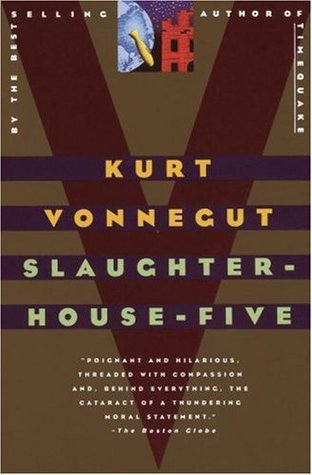
Kurt Vonnegut's Slaughterhouse Five

Chapters Six - Ten


What a powerful book. Fatalism is a fantastic word to describe the philosophy behind it.

fa·tal·ism

  [feyt-l-iz-uhm] 
noun
1. The acceptance of all things and events as inevitable; submission to fate.
2. Philosophy. The doctrine that all events are subject to fate or inevitable predetermination.

The main character is extremely passive in all things, in a very curious way. Vonnegut goes out of his way to say so, like in the first chapters where Billy was begging to be left alone despite being behind enemy lines. This makes much more sense once you realize the Tralfamadorian philosophy is basically fatalism, because all of the main character's actions emphasize this. A great example is when Billy knew he was about to be kidnapped by aliens despite having no warning, so he put on his slippers and went outside to wait for them to take him. That moment was structured that way, whether he wanted to go or not, so why have a profound opinion about it? In fact, I'd argue just about everything about this book was structured to emphasize fatalism. He continually writes about death but brushes it off with "So it goes," instead of making a big scene about it. Why weep for someone who's still alive, just not at this very moment?

One important thing to remember while reading this book is that, because it isn't necessarily in chronological order, it's very important to remember the details. There are many repeticious aspects of the book, going back and forth from one plot to another and back to the first, to using the same lines, "So it goes." The biggest hitter is when a seemingly non-important line is repeated at the end of chapter nine. The story, as far as Billy's life is concerned, basically is from Chapter 2-9 so the end of chapter nine very much feels like the end of the book. This is a clever place to put something special for the readers, since it's not technically the end.

As for chapters one and two, and the other brief moments when Vonnegut inserts himself into Billy's story, this book feels like a very shy memoir. Sometimes he'll describe in detail something Billy said or did or witnessed, then he'd tack on, "That was me," or "I was there." After all, Vonnegut begins the book by explaining that yes, "All this happened, more or less. The war parts, anyway, are pretty much true," (p. 1). This is a clever way for Vonnegut to share his stories mixed with his philosophies because he's so detached from them. This way, when the reader begins the book, the reader thinks, man, this Billy guy is kind of nuts, instead of, man, this Vonnegut guy is kind of nuts. It's a very delicate balance between Billy's story and Vonnegut's support. Vonnegut retains his credibility so we carefully consider the things he's written, instead of brushing it off as some crazy writer, or alternatively, some crazy fictional character.

Quotes
"It is in fact a crime for an American to be poor, even though America is a nation of poor. Every other nation has folk traditions of men who were poor but extremely wise and virtuous, and therefore more estimable than anyone with power and gold. No such tales are told by the American poor. They mock themselves and glorify their betters," (p. 129).

"Trout, incidentally, had written a book about a money tree. It had twenty-dollar bills for leaves. Its flowers were government bonds. Its fruit was diamonds. It attracted human beings who killed each other around the roots and made very good fertilizer. So it goes," (p. 167).

"Trout's leading robot looked like a human being and could talk and dance and so on, and go out with girls. And nobody held it against him that he dropped jellied gasoline on people. But they found his halitosis unforgivable. But then he cleared that up, and he was welcomed to the human race," (p. 168).

"The advocates of nuclear disarmament seem to believe that, if they could achieve their aim, war would become tolerable and decent. They would do well to read this book and ponder the fate of Dresden, where 135,000 people died as the result of an air attack with conventional weapons. On the night of March 9th 1945, an air attack on Tokyo ... using incendiary and high explosive bombs, caused the death of 83,793 people. The atom bomb dropped on Hiroshima killed 71,379 people," (p. 188).

What a crazy, fascinating book. Leave your thoughts in the comments and tell me what you're reading!

Sunday, June 16, 2013

Lit-Savvy Sunday: June 16

I am always looking for new books to read, as evident by my 127-books-long To Read list on Good Reads.  As Sunday makes a great rest day, every Sunday I'll rest from my crochet work to share my thoughts on what I'm reading. Sometimes my biggest struggle is just affording new books (much like yarn, you just want it all) but soon I'll have a public library nearby. Please, join the conversation and tell me what you're reading, from deep philosophical reads to light-hearted romance novels to violent fantasies and beyond, I love it all. Add a link to a post if you wrote up some thoughts on it and I'll be sure to check it out.

Kurt Vonnegut's Slaughterhouse Five

Chapters One - Five


Slaughterhouse Five is about war, life, and time travel.

The first chapter is a little slow while the author works on introducing the main character, but it picks up after that. There were a few times I begrudgingly set the book down when it was time to leave the house.

The book is written to be a series of events, but none of them are in chronological order. This really puts emphasis on the way the Tralfamadorians see time, because by time you read about one event, you already know what happens to all of those characters thirty years from now, the same way the Tralfamadorians already know everything that ever has and ever will happen. The Tralfamadorians, by the way, are aliens. In essence, this book is screaming, "Look at the big picture, you idiot!" Death doesn't matter any more than spilled milk matters in the grand scheme of things. We're here and then we're not but someone else is. So it goes.


Quotes:
"The dead person is in bad condition in that particular moment, but that same person is just fine in plenty of other moments. Now, when I myself hear somebody is dead, I simply shrug and say what the Tralfamadorians say about dead people, which is, 'So it goes.'"

"The flaw in the Christ stories ... was that Christ, who didn't look like much, was actually the Son of the Most Powerful Being in the Universe. Readers understood that, so, when they came to the crucifixion, they naturally thought ...: Oh boy- they sure picked the wrong guy to lynch that time! And that thought had a brother: "There are right people to lynch." Who? People not well connected. So it goes."

"There isn’t any particular relationship between the messages, except that the author has chosen them carefully, so that, when seen all at once, they produce an image of life that is beautiful and surprising and deep. There is no beginning, no middle, no end, no suspense, no moral, no causes, no effects. What we love in our books are the depths of many marvelous moments seen all at one time."